Diploma or degree, Computer Science or Data Science, which university, and what to research before you apply. A guide for Form Four and Form Six leavers who want a career in tech.
↓ Download all 10 slides (ZIP)↓ Download article (TXT)All slide images and the full article in one ZIP, ready to save and read offline.
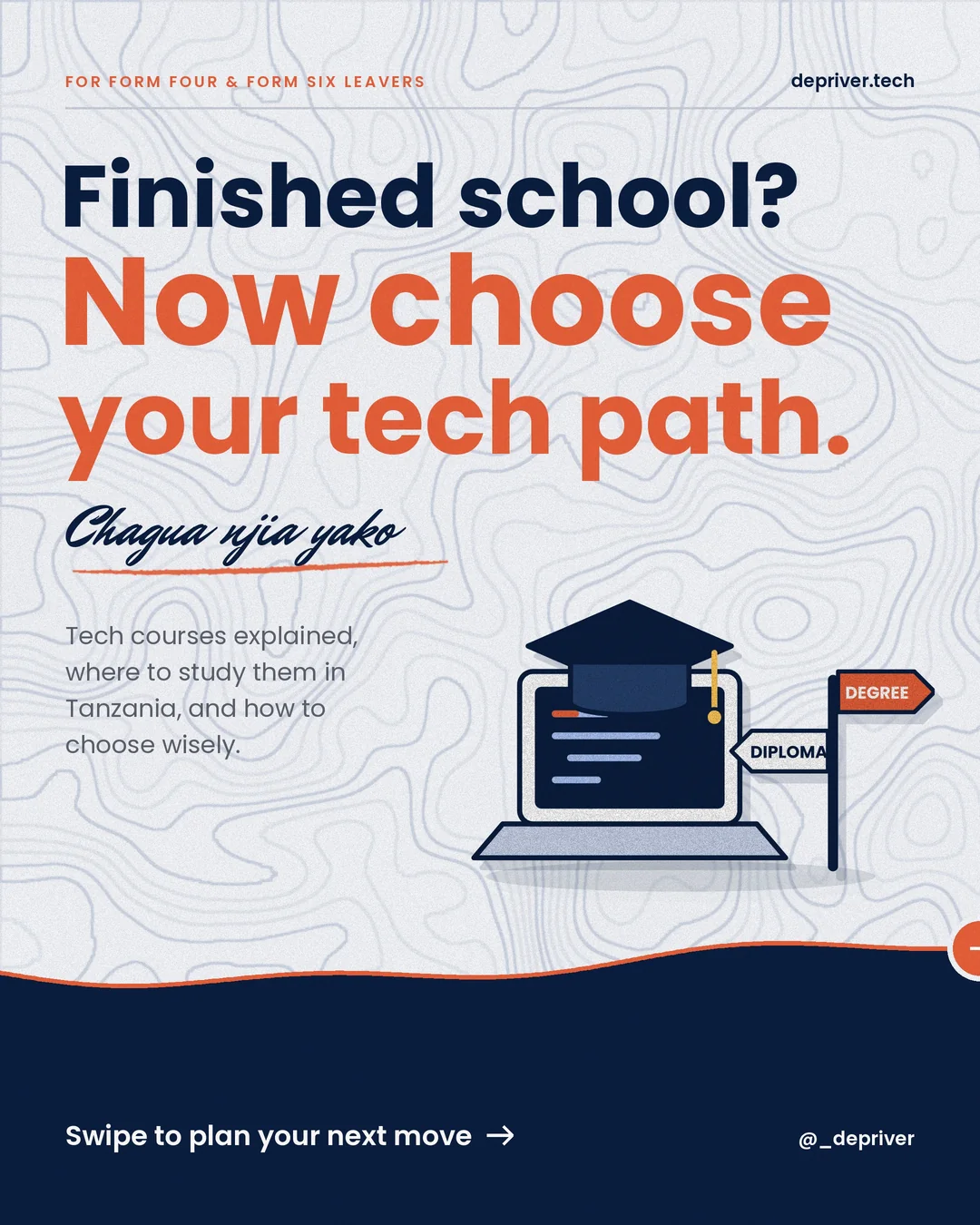
Results are out, and everyone around you has an opinion about what you should study. This post is for anyone finishing Form Four or Form Six who wants a career in tech. Here’s how to choose properly. Chagua njia yako.
Step 1: Know your road
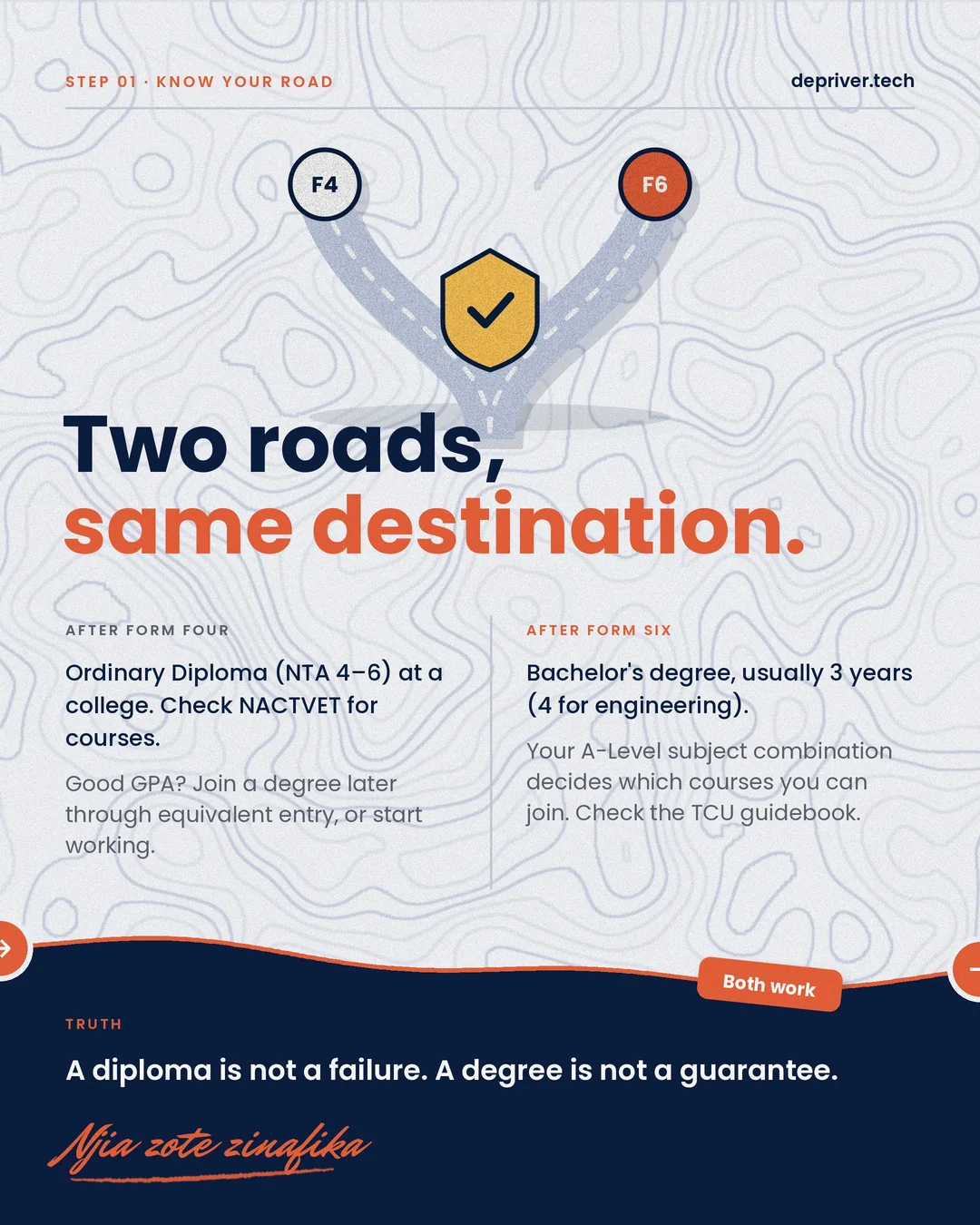
- After Form Four: an Ordinary Diploma (NTA levels 4 to 6) at a college. Check the courses and colleges on NACTVET. Finish with a good GPA and you can join a degree later through equivalent entry, or start working.
- After Form Six: a bachelor’s degree, usually 3 years (4 for engineering programmes). Your A-Level subject combination decides which programmes you can join.
A diploma is not a failure, and a degree is not a guarantee. Njia zote zinafika.
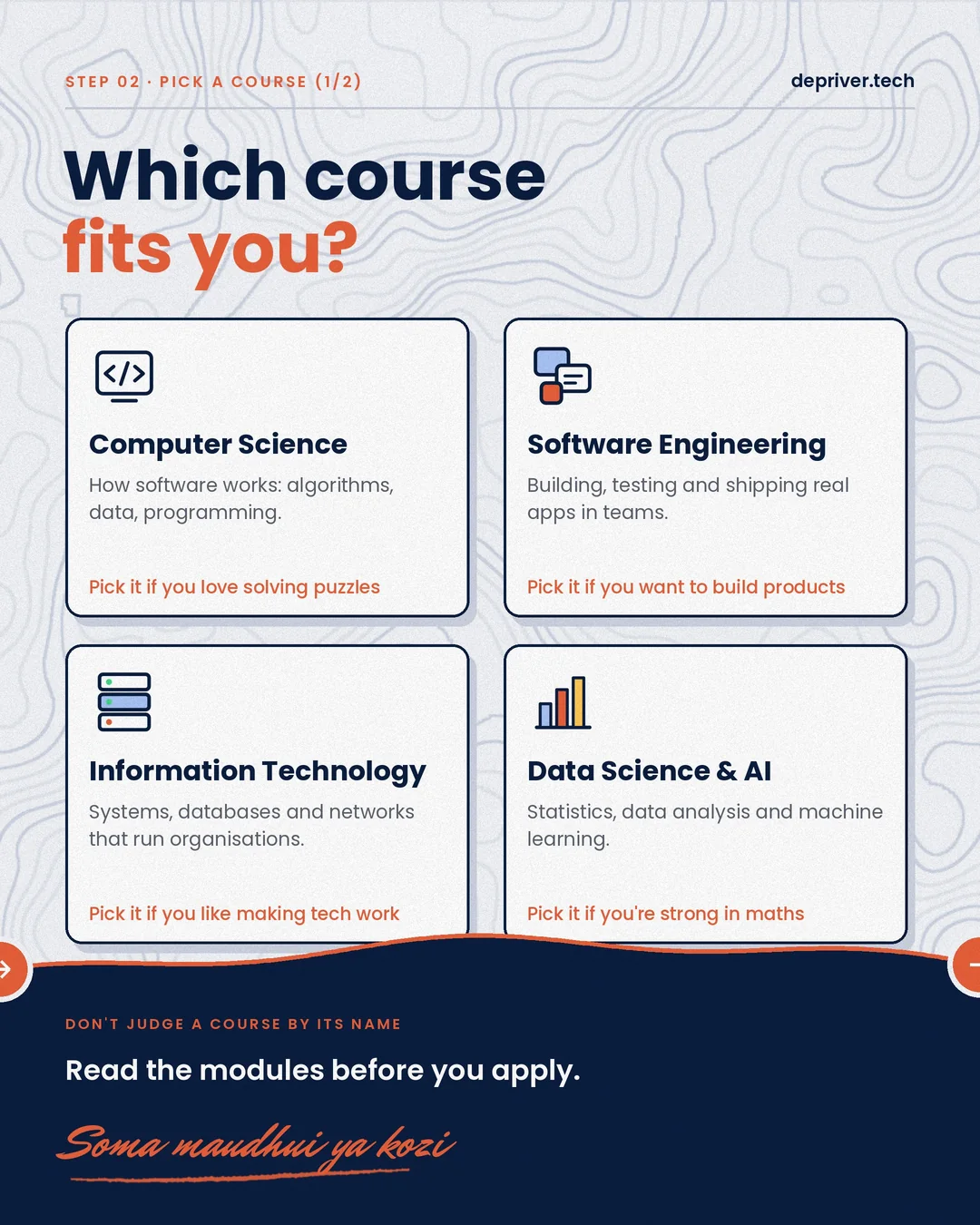
Step 2: Pick a course that fits you
| Course |
What you’ll learn |
Pick it if |
| Computer Science |
How software works: algorithms, data, programming |
you love solving puzzles |
| Software Engineering |
Building, testing and shipping real apps in teams |
you want to build products |
| Information Technology |
Systems, databases and networks that run organisations |
you like making tech work for people |
| Data Science & AI |
Statistics, data analysis and machine learning |
you’re strong in maths |
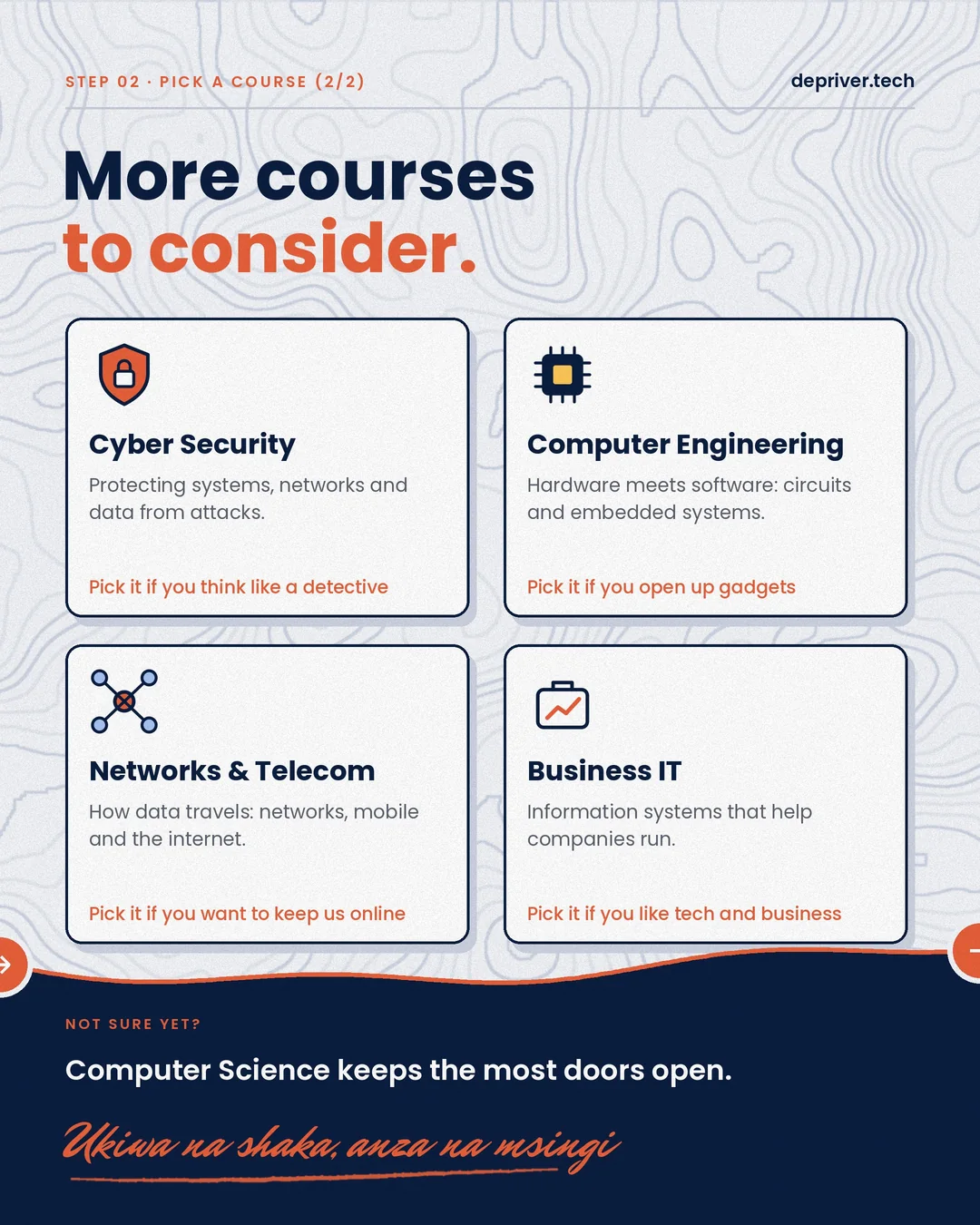
| Cyber Security |
Protecting systems, networks and data from attacks |
you think like a detective |
| Computer Engineering |
Hardware meets software: circuits and embedded systems |
you open up gadgets to see inside |
| Networks & Telecom |
How data travels: networks, mobile and the internet |
you want to keep the country online |
| Business IT / Information Systems |
Systems that help companies run |
you like both tech and business |
Don’t judge a course by its name: read the modules. Not sure yet? Computer Science keeps the most doors open.
Step 3: Know where to study
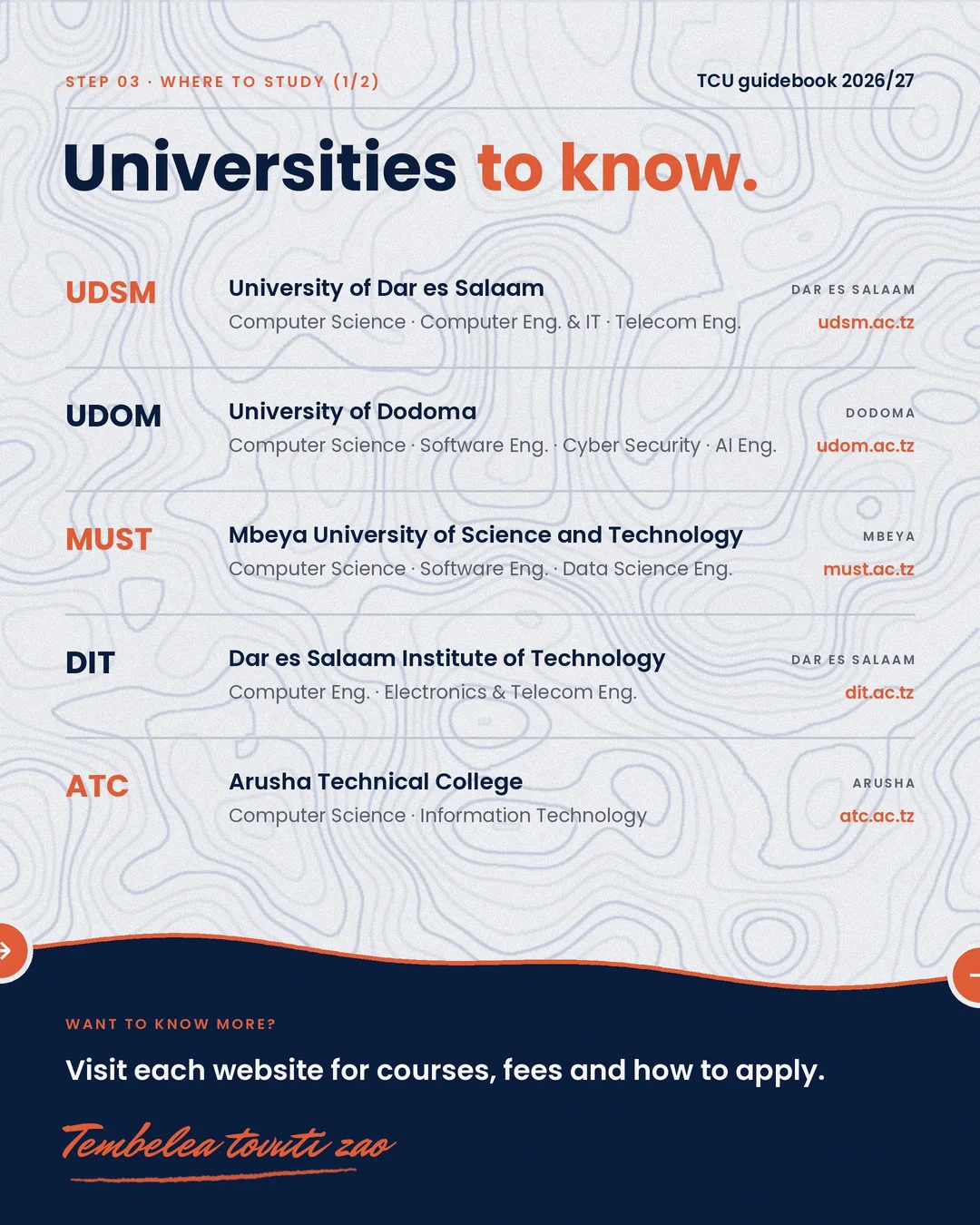
From the TCU Bachelor’s Degree Admission Guidebook 2026/2027 (a selection, not the full list). Click a website to see courses, fees and how to apply.
Universities to know
- UDSM, University of Dar es Salaam (Dar es Salaam): Computer Science, Computer Engineering & IT, Telecommunications Engineering. Website: udsm.ac.tz
- UDOM, University of Dodoma (Dodoma): Computer Science, Software Engineering, Cyber Security & Digital Forensics, AI Engineering. Website: udom.ac.tz
- MUST, Mbeya University of Science and Technology (Mbeya): Computer Science, Software Engineering, Data Science Engineering. Website: must.ac.tz
- DIT, Dar es Salaam Institute of Technology (Dar es Salaam): Computer Engineering, Electronics & Telecommunication Engineering. Website: dit.ac.tz
- ATC, Arusha Technical College (Arusha): Computer Science, Information Technology. Website: atc.ac.tz
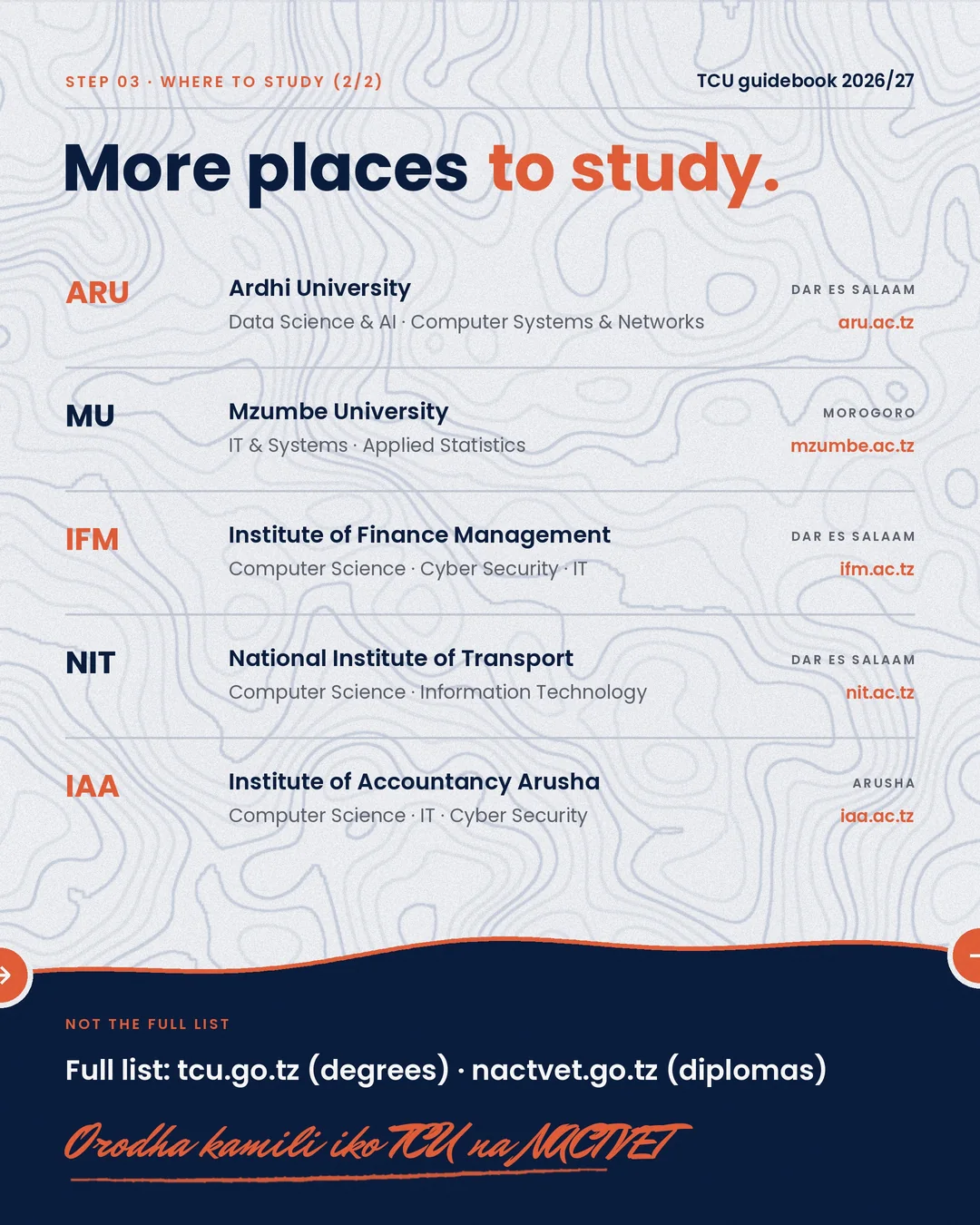
More places to study
- ARU, Ardhi University (Dar es Salaam): Data Science & AI, Computer Systems & Networks. Website: aru.ac.tz
- MU, Mzumbe University (Morogoro): IT & Systems, Applied Statistics. Website: mzumbe.ac.tz
- IFM, Institute of Finance Management (Dar es Salaam): Computer Science, Cyber Security, IT. Website: ifm.ac.tz
- NIT, National Institute of Transport (Dar es Salaam): Computer Science, Information Technology. Website: nit.ac.tz
- IAA, Institute of Accountancy Arusha (Arusha): Computer Science, IT, Cyber Security. Website: iaa.ac.tz
Many of these also run diplomas for Form Four leavers. For the full lists, see tcu.go.tz for degrees and nactvet.go.tz for diplomas. Tembelea tovuti zao.
Step 4: Check the entry rules
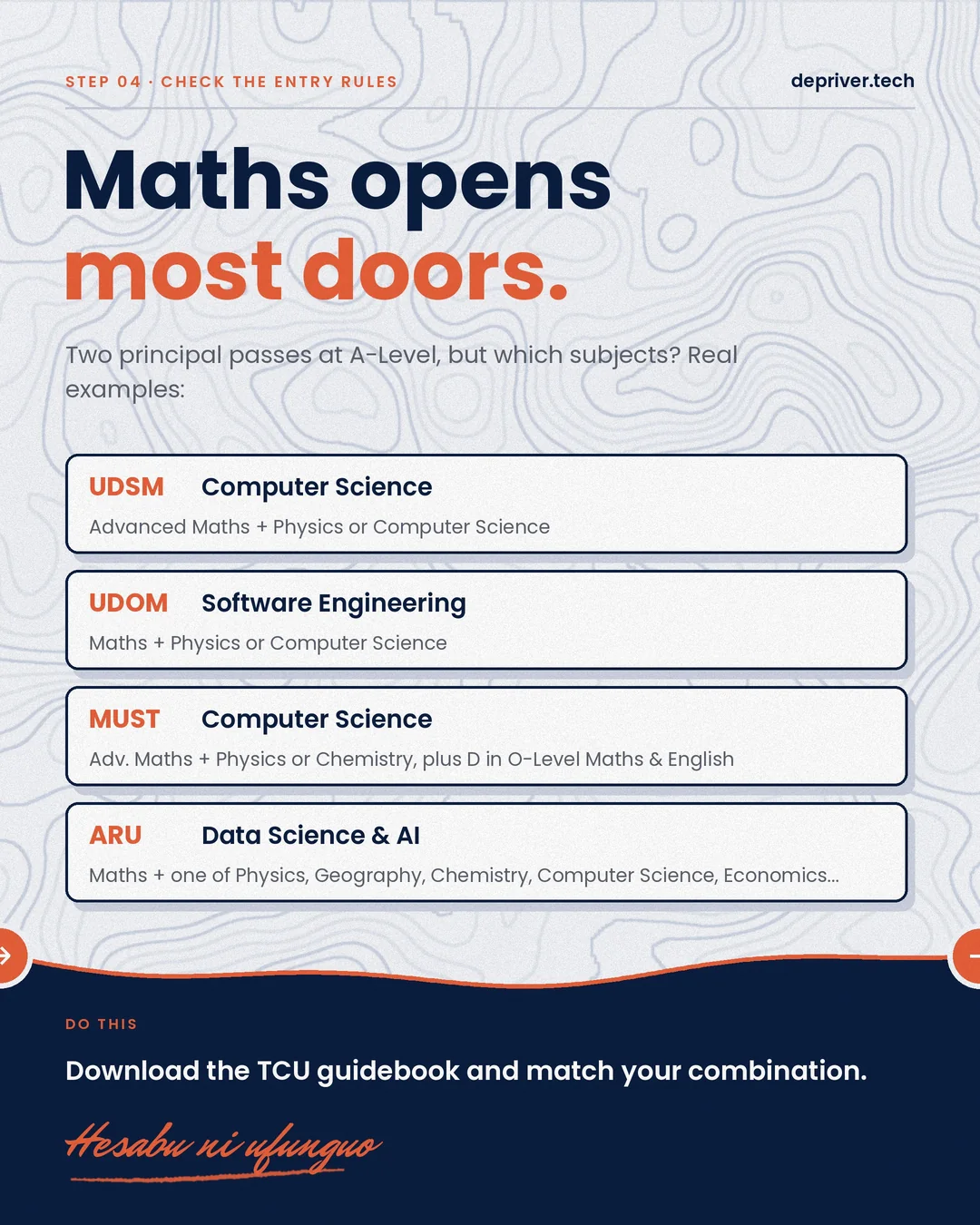
You need two principal passes at A-Level, but which subjects depends on the programme. Some real examples from the 2026/27 guidebook:
- UDSM, Computer Science: Advanced Mathematics and Physics or Computer Science
- UDOM, Software Engineering: Mathematics and either Physics or Computer Science
- MUST, Computer Science: Advanced Mathematics and Physics or Chemistry, plus at least a D in Basic Mathematics and English at O-Level
- ARU, Data Science & AI: Mathematics and one of Physics, Geography, Chemistry, Computer Science, Economics, Business Studies or Accountancy
Maths opens most doors. Hesabu ni ufunguo. Download the guidebook and match it against your own combination.
Step 5: Research before you apply
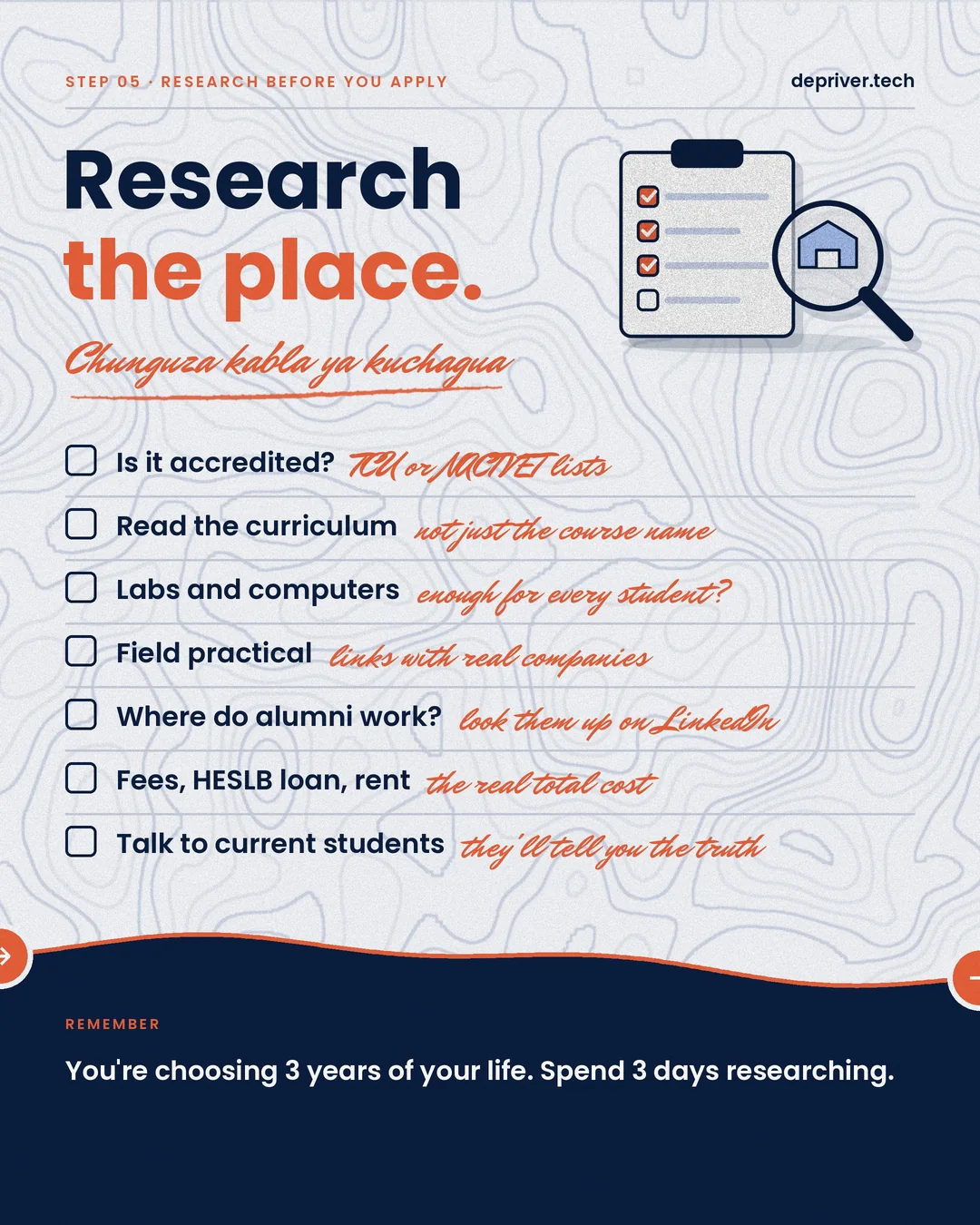
- Is it accredited? Check the TCU or NACTVET lists.
- Read the curriculum, not just the course name.
- Are there enough labs and computers for every student?
- Does it have field practical and links with real companies?
- Where do its alumni work? Look them up on LinkedIn.
- What’s the real total cost: fees, HESLB loan eligibility, rent?
- Talk to current students. They’ll tell you the truth.
You’re choosing three years of your life. Spend at least three days researching. Chunguza kabla ya kuchagua.
Step 6: Make your own choice
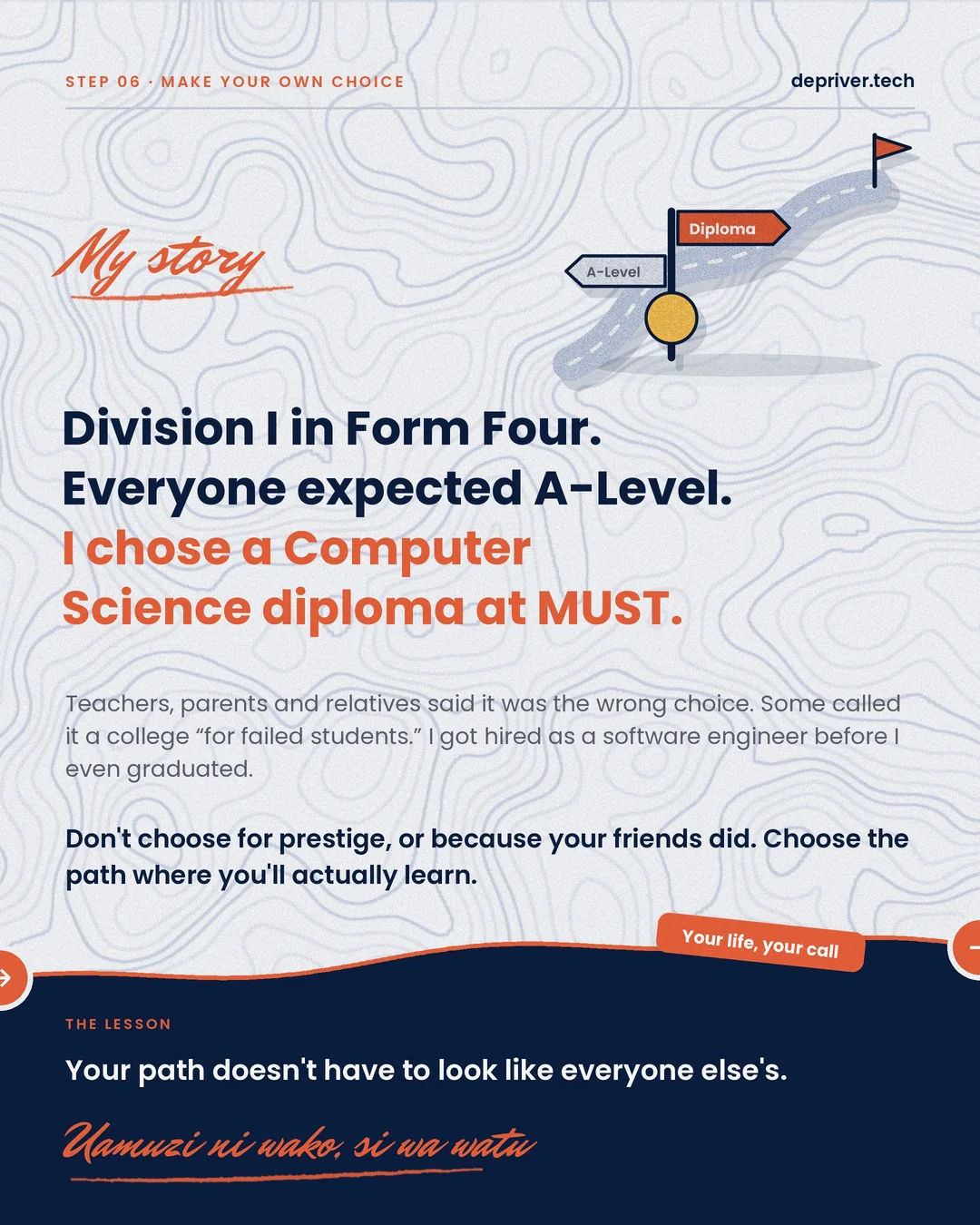
I got Division I in Form Four, and everyone expected me to go to A-Level. I chose a Computer Science diploma at MUST instead. Teachers, parents and relatives said it was the wrong choice, and some people called it a college “for failed students”. I was hired as a software engineer before I even graduated.
Don’t choose for prestige, or because your friends did. Choose the path where you’ll actually learn. Uamuzi ni wako, si wa watu.
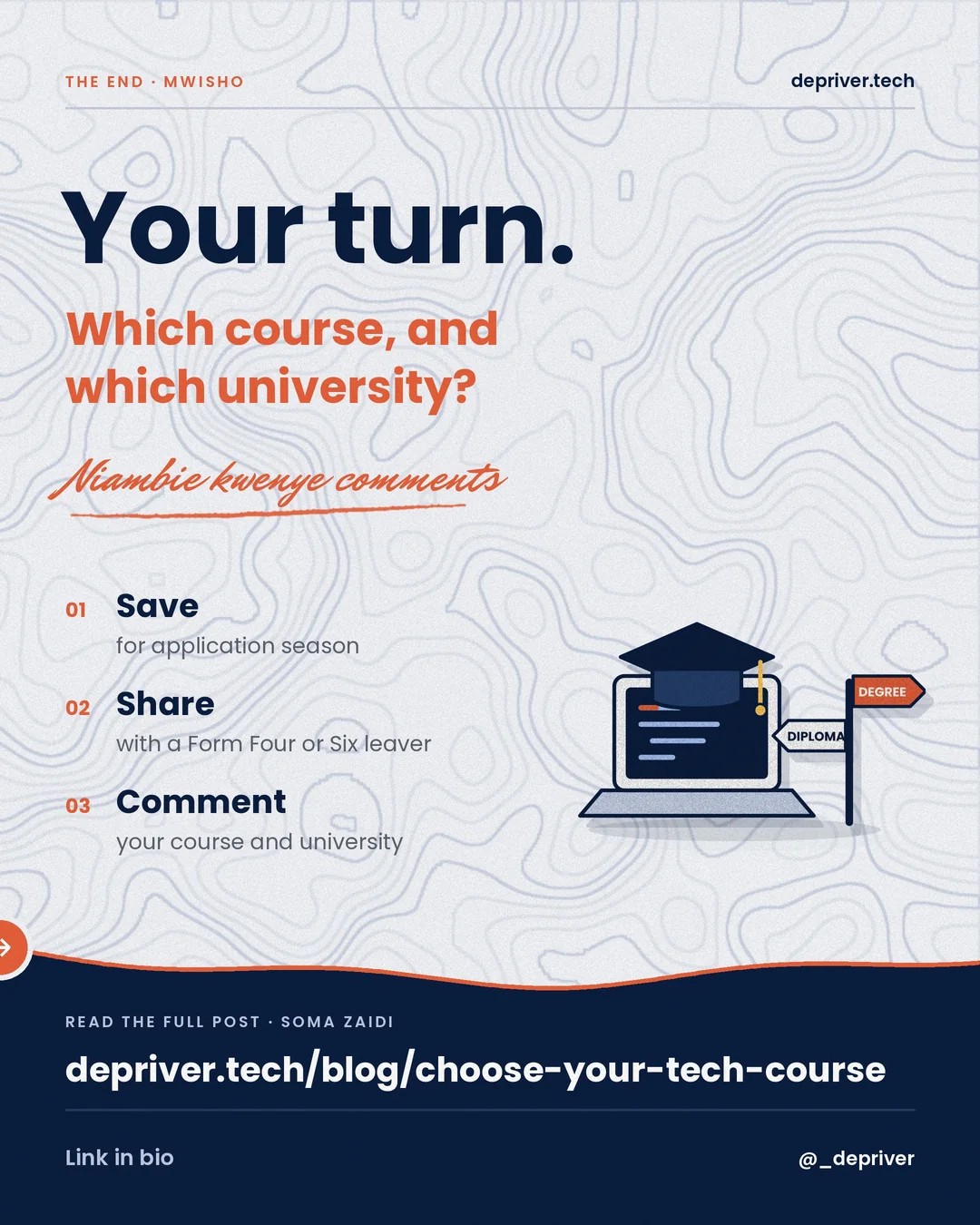
Which course are you choosing, and at which university? Niambie kwenye comments, and share this with a Form Four or Form Six leaver who’s deciding right now.
 9 slides
 8 slides
 8 slides