What a portfolio is, how to get projects when you have none, ideas by track, why three beats ten, how to present each project as a mini case study, where to put it and how to keep it alive.
↓ Download all 12 slides (ZIP)↓ Download article (TXT)All slide images and the full article in one ZIP, ready to save and read offline.
“I have no experience, so I have nothing to show.” I hear this from students every week. But a portfolio isn’t something you have; it’s something you build, one project at a time, starting from zero. Kazi yako ijieleze.
A CV claims, a portfolio proves
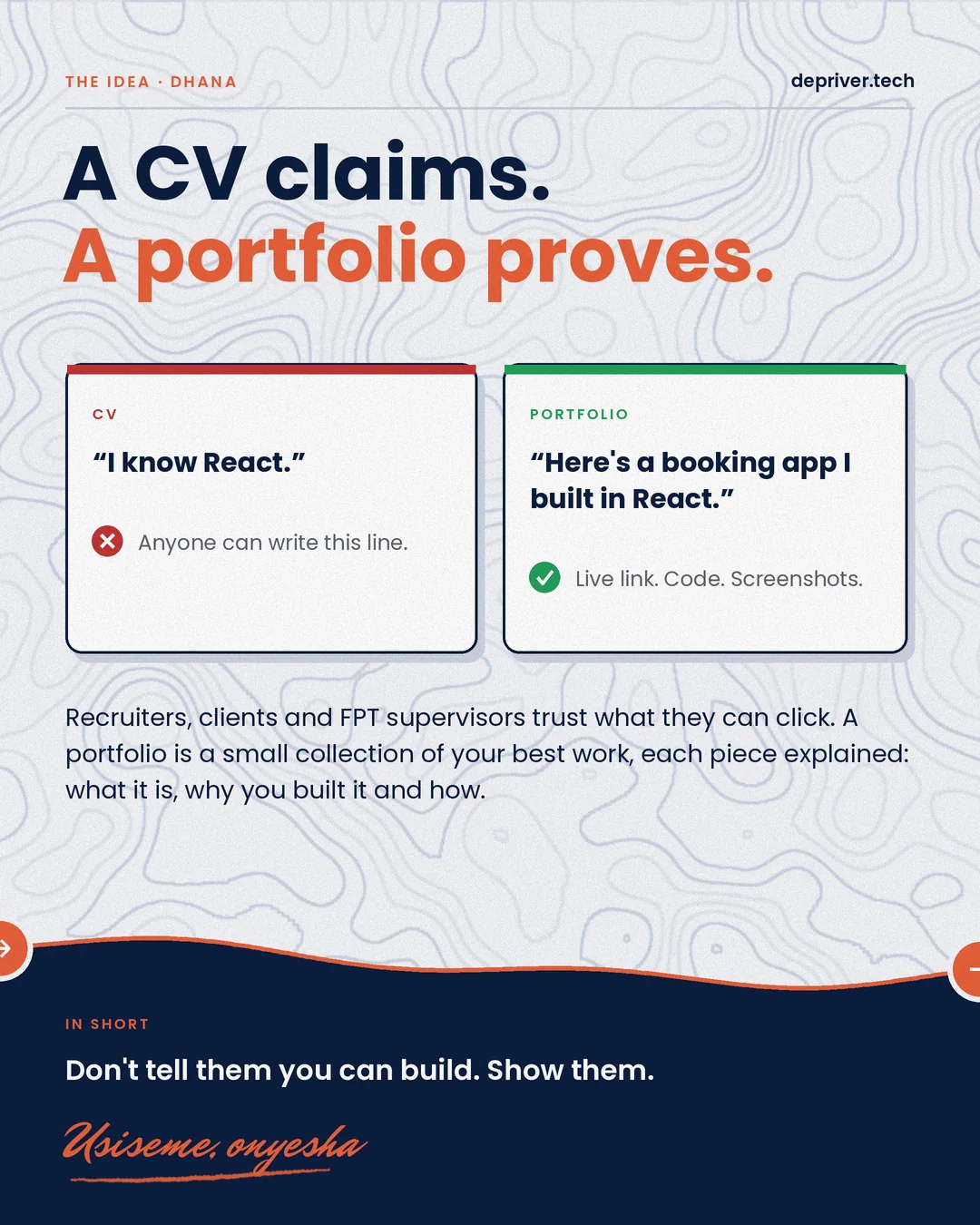
Anyone can write “I know React” on a CV. A portfolio says “here’s a booking app I built in React”, with a live link, the code and screenshots. Recruiters, clients and FPT supervisors trust what they can click.
A portfolio is a small collection of your best work, with each piece explained: what it is, why you built it and how. Don’t tell them you can build. Show them. Usiseme, onyesha.
No projects yet? Climb the ladder
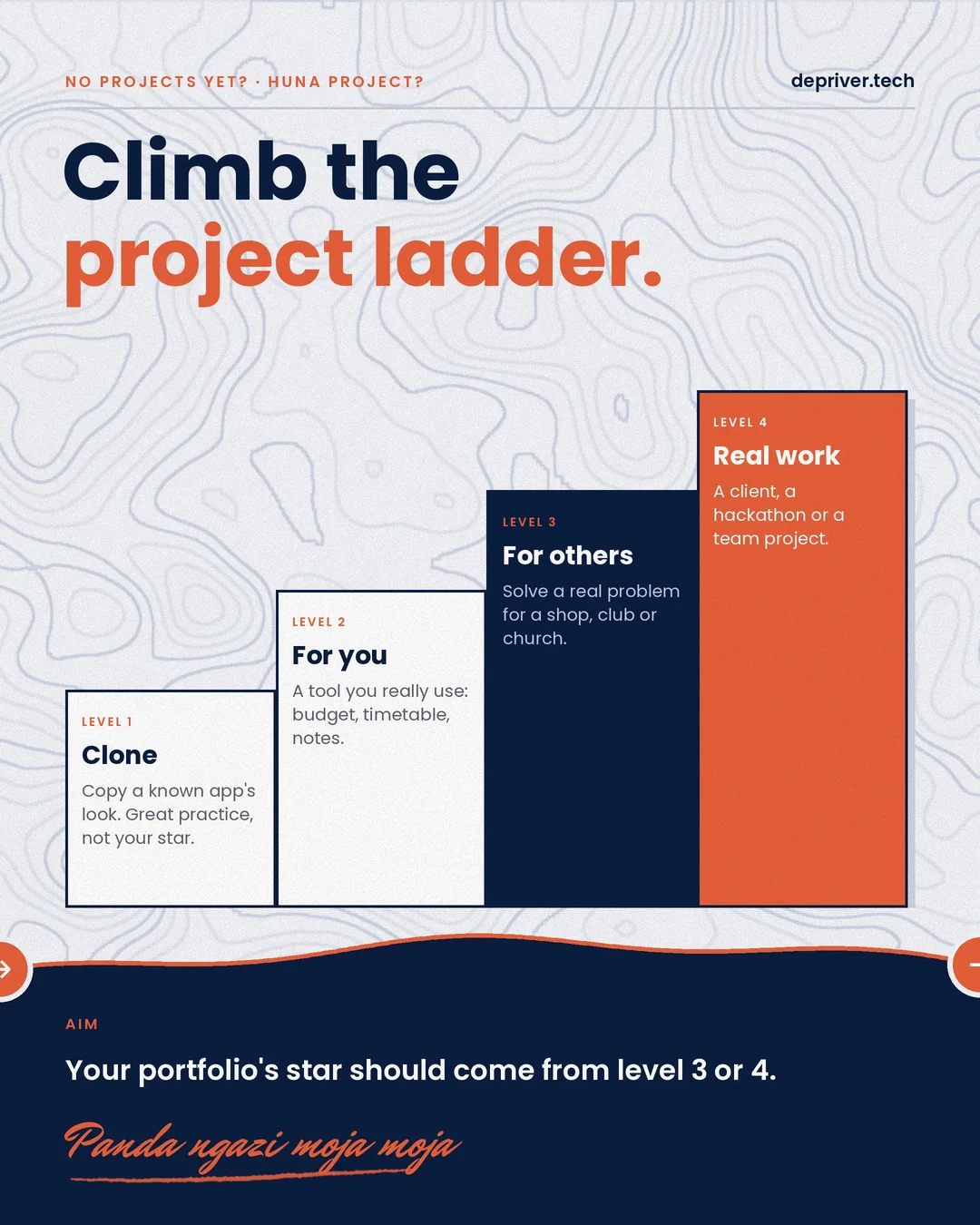
- Clone. Copy the look of a known app. Great practice, but not your star; everyone has the same clones.
- For you. Build a tool you actually use: a budget tracker, a timetable, a notes app.
- For others. Solve a real problem for a shop, a club, your church or your hostel group.
- Real work. A client, a hackathon or a team project.
Your portfolio’s star project should come from level 3 or 4. Panda ngazi moja moja.
Ideas you can start this week
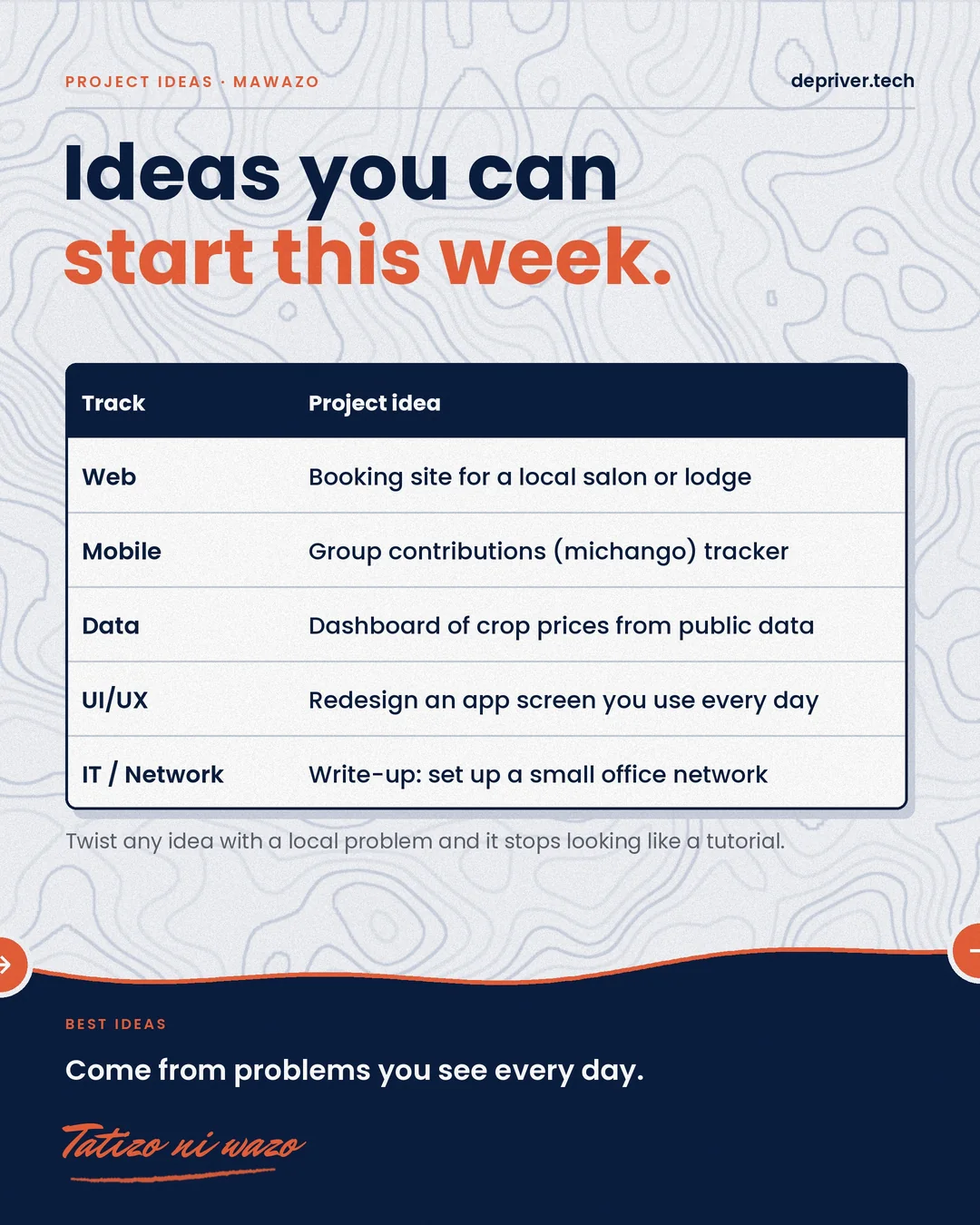
| Track |
Project idea |
| Web |
A booking site for a local salon or lodge |
| Mobile |
A group contributions (michango) tracker |
| Data |
A dashboard of crop prices from public data |
| UI/UX |
A redesign of an app screen you use every day |
| IT / Network |
A write-up of setting up a small office network |
Give any idea a twist from a local problem and it stops looking like a tutorial. The best ideas come from problems you see every day. Tatizo ni wazo.
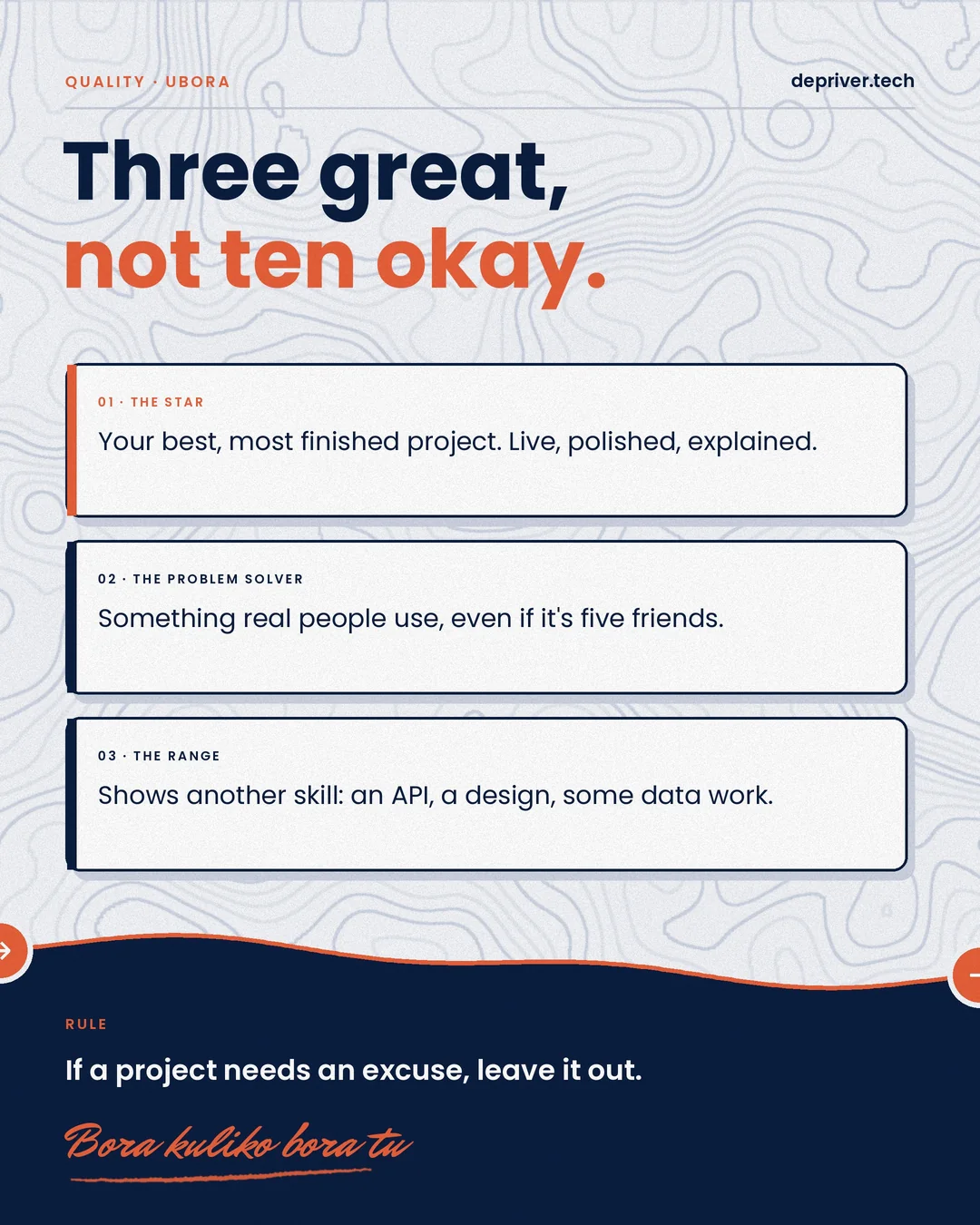
Three great, not ten okay
Reviewers don’t have time for fifteen projects. Pick three:
- The star: your best, most finished project. Live, polished, explained.
- The problem solver: something real people use, even if it’s five friends.
- The range: something that shows another skill, like an API, a design or some data work.
If a project needs an excuse (“it’s not finished, but…”), leave it out.
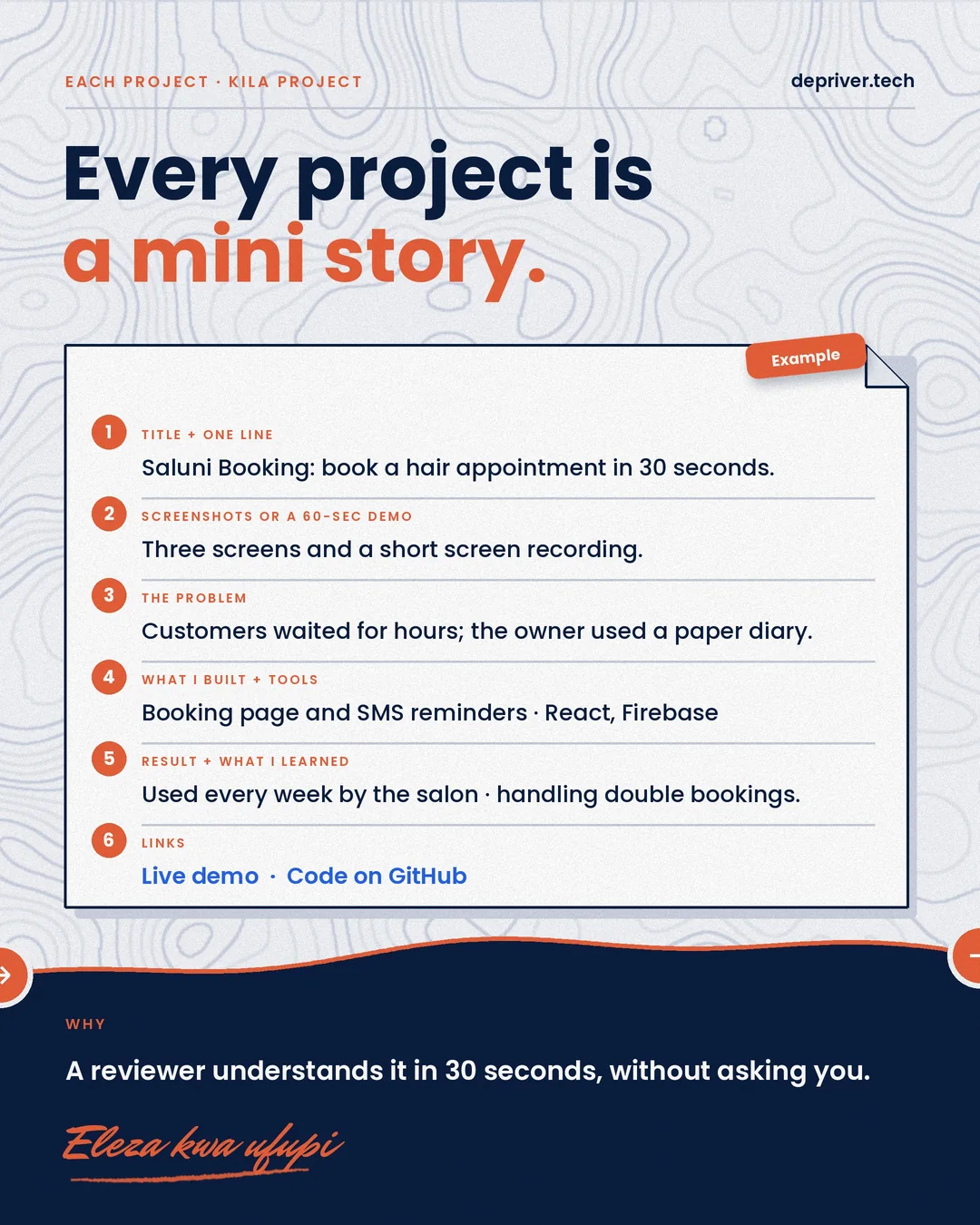
Every project is a mini story
For each project, show:
- A title and one line: “Saluni Booking: book a hair appointment in 30 seconds.”
- Screenshots or a 60-second demo: three screens and a short screen recording.
- The problem: “Customers waited for hours; the owner used a paper diary.”
- What you built, and with what: “A booking page and SMS reminders · React, Firebase.”
- The result and what you learned: “Used every week by the salon · I learned to handle double bookings.”
- Links: the live demo and the code on GitHub.
A reviewer should understand it in 30 seconds, without asking you anything. Eleza kwa ufupi.
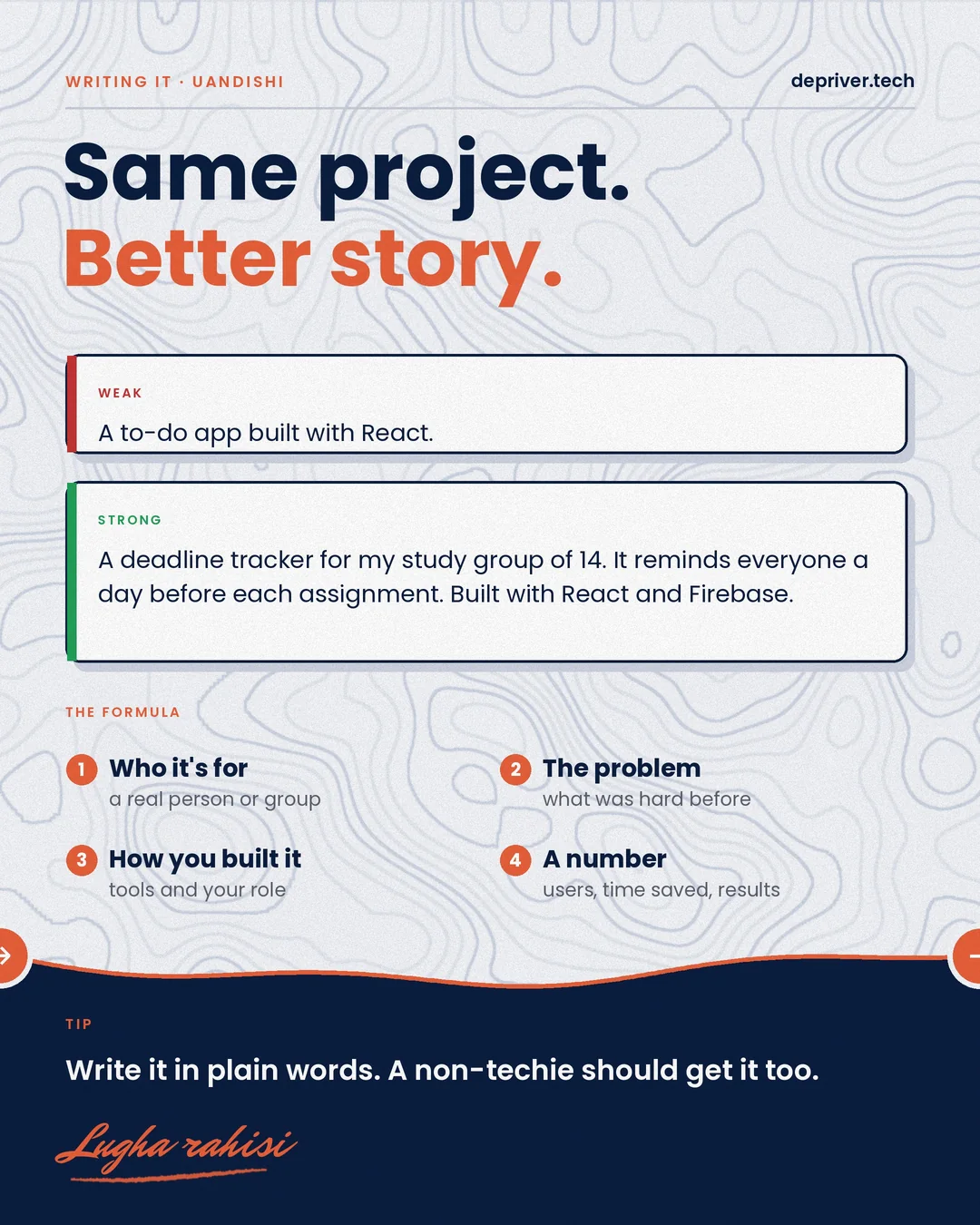
Same project, better story
Weak:
A to-do app built with React.
Strong:
A deadline tracker for my study group of 14. It reminds everyone a day before each assignment. Built with React and Firebase.
The formula: who it’s for, the problem, how you built it and a number (users, time saved, results). Write in plain words; someone who isn’t technical should get it too. Lugha rahisi.
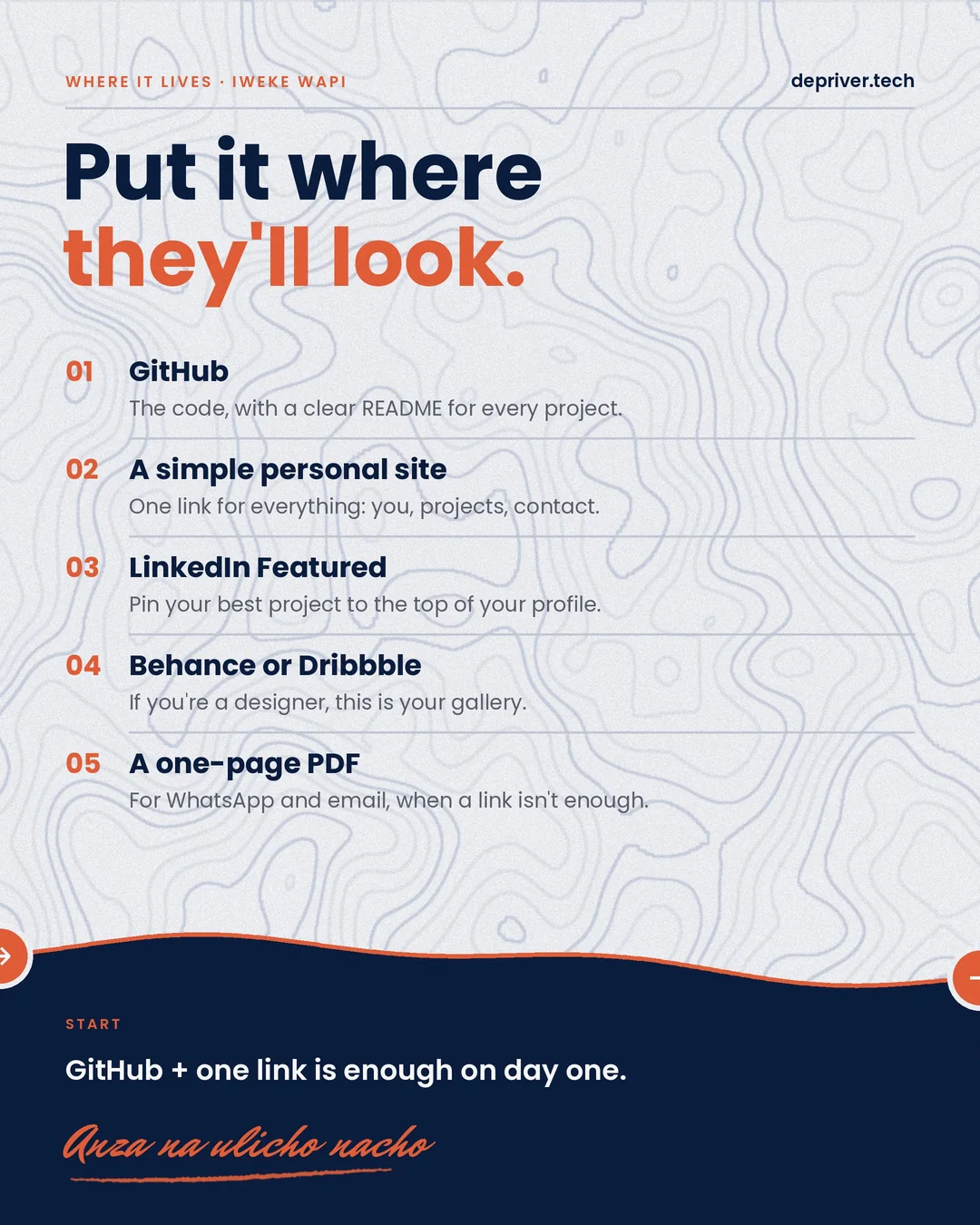
Put it where they’ll look
- GitHub: the code, with a clear README for every project.
- A simple personal site: one link for everything: you, your projects, your contact.
- LinkedIn Featured: pin your best project to the top of your profile.
- Behance or Dribbble: if you’re a designer, this is your gallery.
- A one-page PDF: for WhatsApp and email, when a link isn’t enough.
On day one, GitHub plus one link is enough. Anza na ulicho nacho.
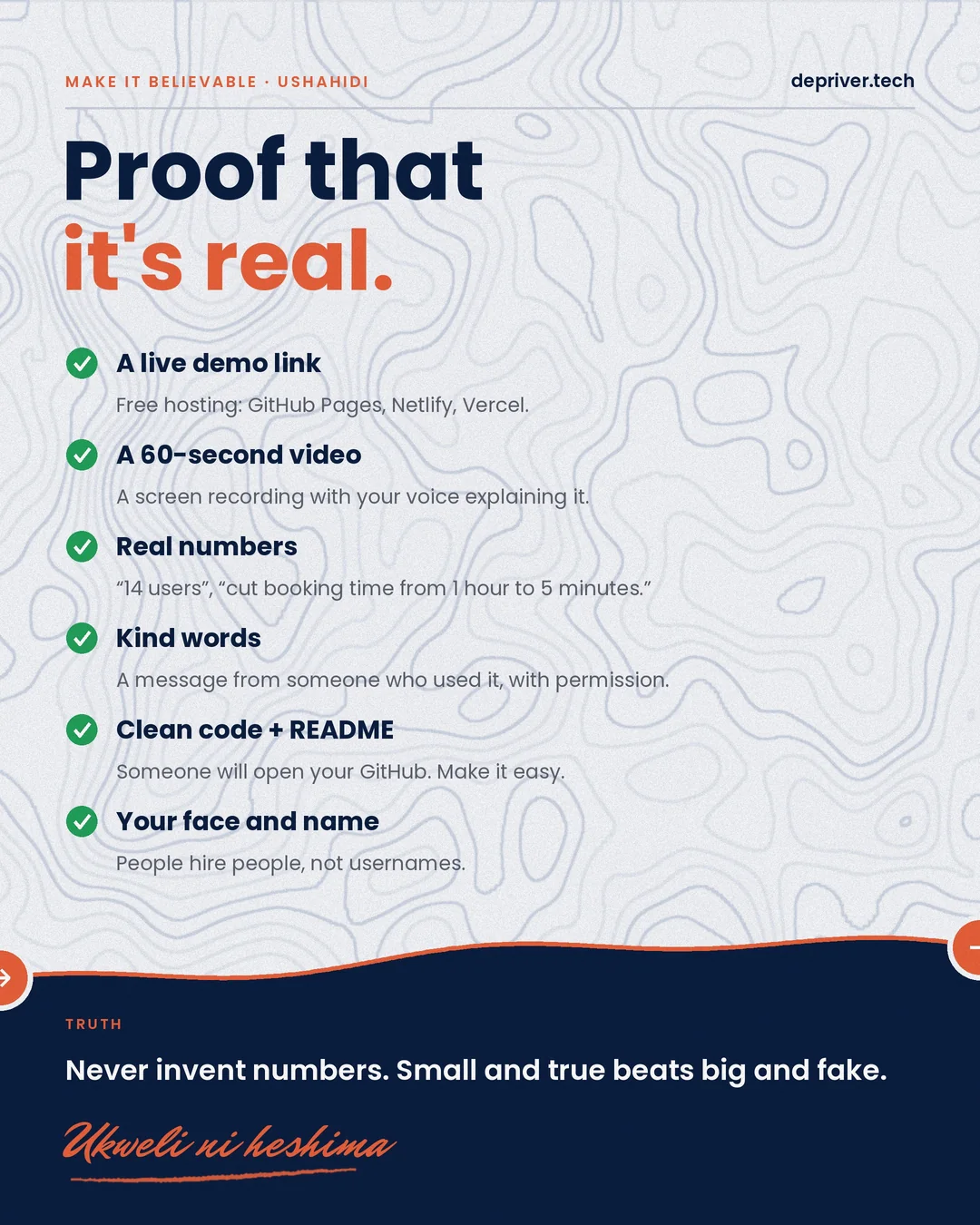
Proof that it’s real
- A live demo link. Hosting is free on GitHub Pages, Netlify or Vercel.
- A 60-second video, a screen recording with your voice explaining it.
- Real numbers: “14 users”, “cut booking time from an hour to five minutes”.
- Kind words from someone who used it, shared with permission.
- Clean code and a README. Someone will open your GitHub.
- Your face and name. People hire people, not usernames.
Never invent numbers. Small and true beats big and fake. Ukweli ni heshima.
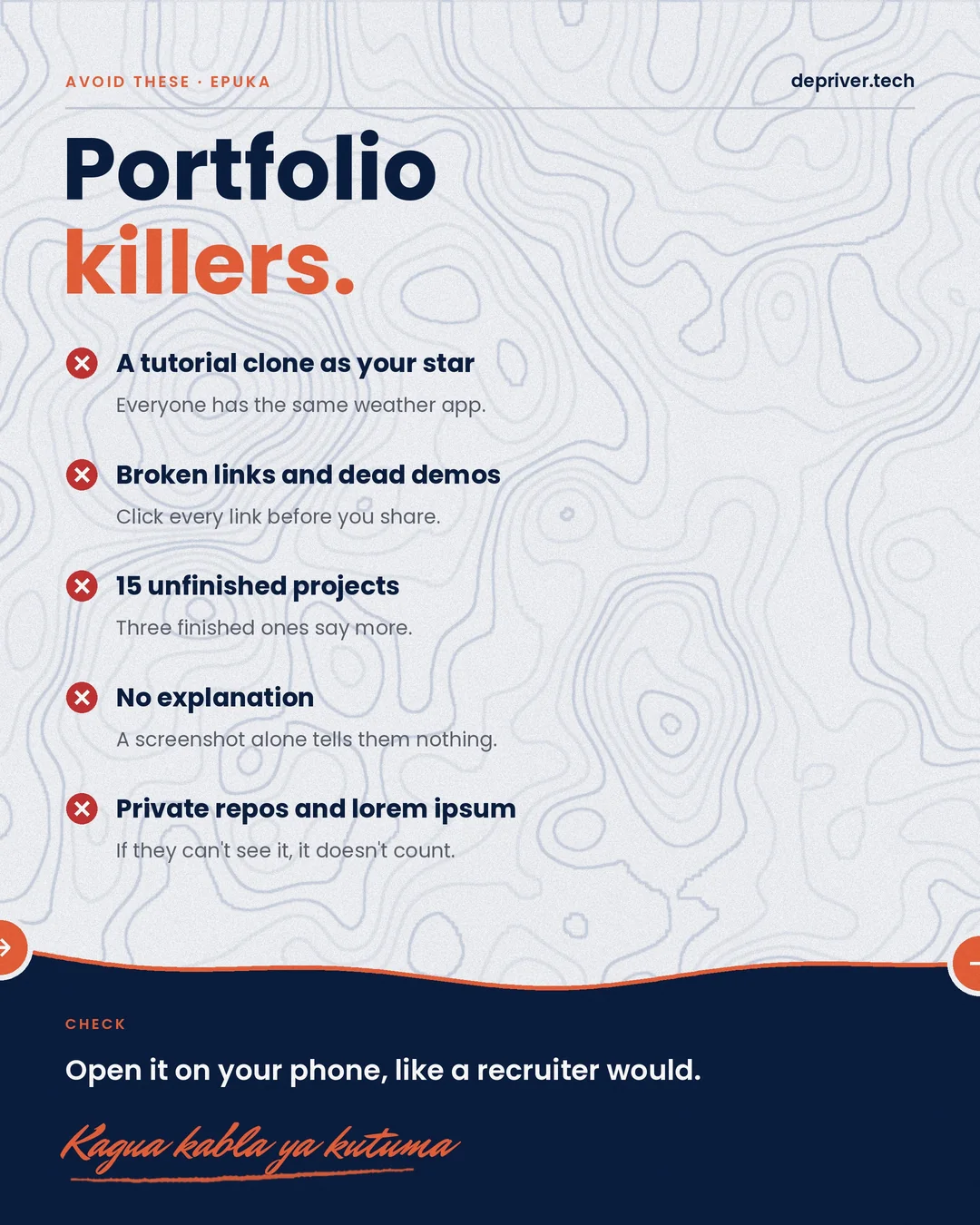
Portfolio killers
- A tutorial clone as your star project.
- Broken links and dead demos. Click every link before you share.
- Fifteen unfinished projects. Three finished ones say more.
- No explanation. A screenshot alone tells them nothing.
- Private repos and lorem ipsum. If they can’t see it, it doesn’t count.
Before you share, open it on your phone, the way a recruiter would.
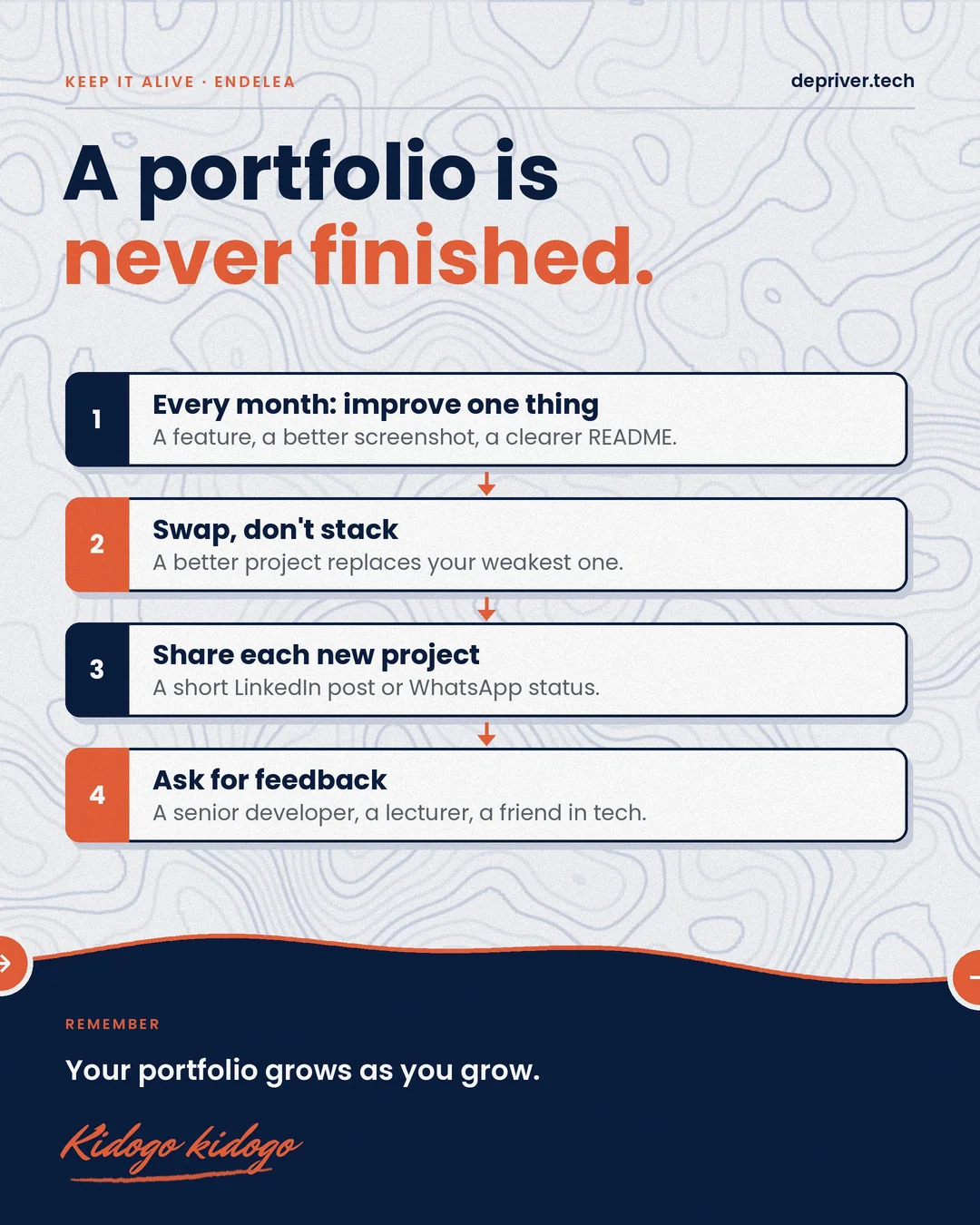
A portfolio is never finished
- Every month, improve one thing: a feature, a better screenshot, a clearer README.
- Swap, don’t stack: a better project replaces your weakest one.
- Share each new project in a short LinkedIn post or on your WhatsApp status.
- Ask for feedback from a senior developer, a lecturer or a friend in tech.
Your portfolio grows as you grow. Kidogo kidogo.
Drop your portfolio link (or your first project idea) in the comments. I’ll take a look.